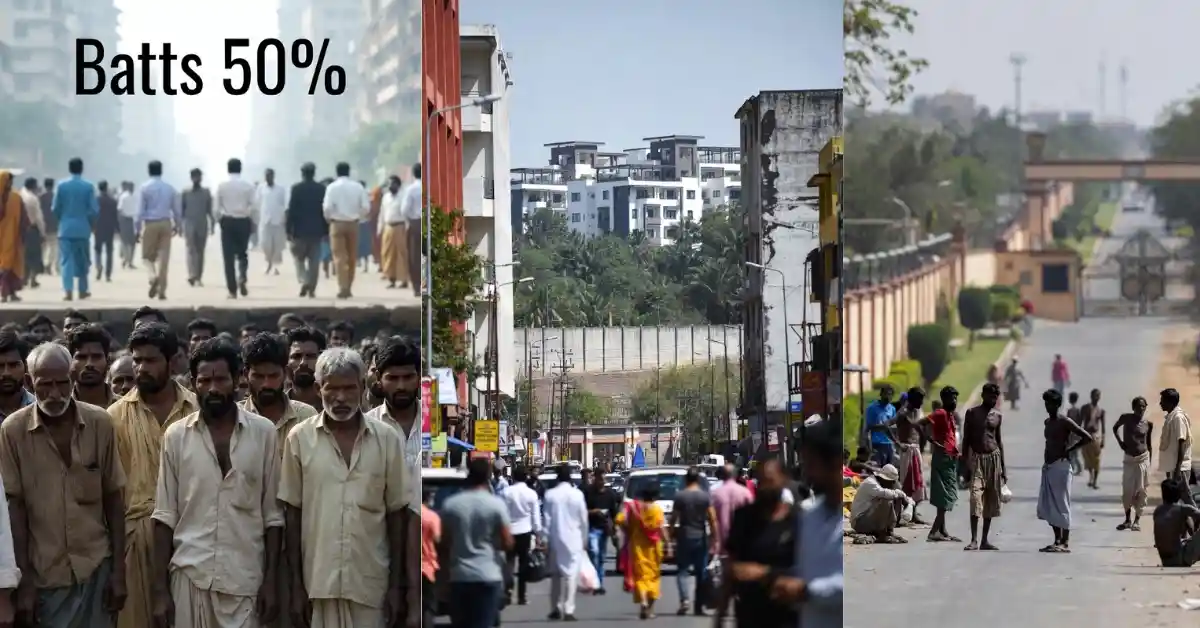
New Delhi: The gap between India’s richest and the rest has never been wider. A new global study lays bare how the top earners are walking away with the lion’s share of the country’s growth, leaving millions behind in the dust.
India’s inequality hits record high, with the wealthiest 10% now pocketing 58% of the national income while the bottom half of the population scrapes by on just 15%, according to the freshly released World Inequality Report 2026.
This marks a slight uptick from 2021 levels, painting a picture of deepening economic divides that experts say could reshape the nation’s social fabric.
Income Disparities: A Closer Look at the Numbers
Drawing from data across 180 countries, the report – put together by over 200 researchers including heavyweights like Thomas Piketty – shows India’s average annual per capita income at about 6,200 euros in purchasing power parity terms, or roughly Rs 5.56 lakh.
But that average hides a brutal reality: the top 10% average earners take home 58% of the pie, up from 57% a few years back. On the flip side, the bottom 50% – that’s over 700 million people – see their share creep up marginally to 15% from 13%.
It’s not just numbers on a page; folks in smaller towns and villages I’ve spoken to over the years echo this frustration. Wages for daily laborers haven’t kept pace with rising costs, while urban salaries for the elite soar. The report flags this as one of the sharpest income gaps globally, second only to South Africa where the top 10% grab 66%.
Wealth Concentration: Even Starker Than Income
When it comes to assets like property, stocks, and savings, the skew is even more glaring. India’s inequality hits record high in wealth terms too, with the richest 10% controlling 65% of total riches and the top 1% – a tiny elite of about 9 million people – holding nearly 40%.
Average per capita wealth sits at around 28,000 euros (Rs 25 lakh), but for the bottom 50%, it’s a modest Rs 6.2 lakh per person.
At the extreme end, the report spotlights the ultra-rich: the top 0.001% (roughly 56,000 individuals) boast average wealth exceeding 10 million euros each, or over Rs 90 crore.
This concentration has roots in policy shifts since the 1990s, but recent years have seen it accelerate, with wealth inequality edging up despite overall economic expansion.
Gender and Global Angles: Broader Cracks in the System
India’s story isn’t isolated – it’s amplified by gender barriers that stifle half the workforce. Female labor force participation hovers at a dismal 15.7%, meaning for every 100 men in jobs, just 15-16 women are employed, a rate unchanged over the last decade.
Globally, women capture only 25% of total labor income, but in India, cultural and structural hurdles make it tougher, from limited access to education to unsafe workplaces.
Zoom out to the world stage, and the patterns repeat: the global top 10% own 75% of wealth and 53% of income, while the bottom 50% holds a mere 2% of assets and 8% of earnings.
Europe fares better – think Sweden or Norway, where the bottom half gets 25% of income – but Latin America rivals India, with Brazil and Mexico seeing top 10% shares around 60%.
One telling shift: back in 1980, much of India’s population sat in the global middle 40% income bracket. Fast-forward to 2025, and nearly everyone has slipped into the bottom 50%, while China has climbed higher.
Environmentally, it’s worse – the world’s richest 10% drive 77% of carbon emissions, compared to 3% from the poorest half.
India’s Inequality Hits Record High: Echoes from the Ground
Years of tracking these trends on the beat – from Mumbai boardrooms to rural Bihar hamlets – show how these stats play out in real lives. Small business owners struggle with credit access, while billionaires multiply fortunes unchecked. The report, edited by Lucas Chancel, Ricardo Gómez-Carrera, Rowaida Moshrif, and Piketty, calls for better data transparency to track and tackle this.